In this article
Public charging tariffs in many European countries have risen in recent years, driven by higher energy prices, reduced subsidies and the growing investment needs of charging point operators. In markets with limited competition, the risk of further price increases becomes even greater. Meanwhile, public charging networks continue to expand, though mounting grid congestion is raising questions about whether this growth can be sustained.
As a result, many EV owners without private parking rely on nearby public chargers or alternative solutions close to home. This often makes electric driving less predictable: prices vary widely, charging points are frequently occupied and not always conveniently located. Fortunately, a wave of new innovations is emerging that can make home-adjacent charging easier and more affordable—even without a driveway. Below are the six most promising solutions.
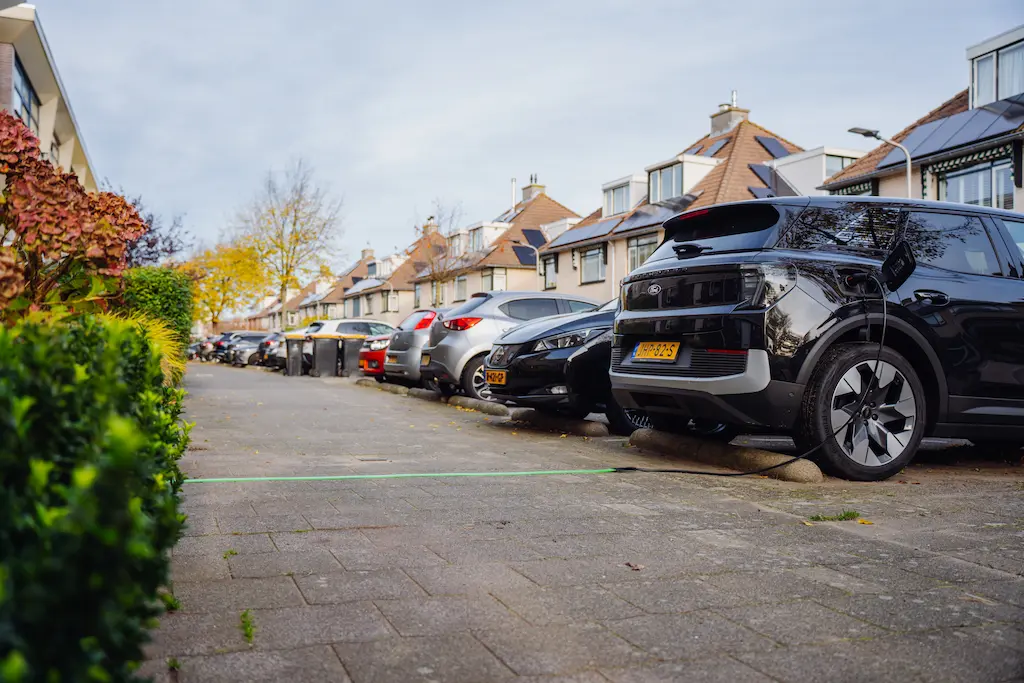
1. FlatPower: the ultra flat charging cable
FlatPower offers a simple way to charge at home even when you park on the street. The flat cable lies flush on the pavement, allowing pedestrians to walk over it safely while keeping the sidewalk accessible. The key benefit is that you can use your own home charger, which allows for smart charging with dynamic tariffs or solar energy. It gives the convenience of private charging while your car is parked in public space.
Some municipalities may require approval because the cable crosses public pavement. In many places, these solutions are tolerated or even encouraged. FlatPower works best on level surfaces. On uneven pavements, the cable may not lie as securely.
2. Voltbee: sharing a home charger
Voltbee is a sharing concept that allows residents to make their private chargers available to neighbours. For people without a driveway, this provides access to nearby charge points that are often cheaper and closer than public chargers. Prices are typically around twenty percent lower, and users can reserve a charger for added certainty. Charging is managed easily through an app with transparent rates.
This model is also environmentally friendly because private chargers are used only a small percentage of the time. Sharing this unused capacity reduces the need for new public chargers, limits pressure on the electricity grid and helps preserve public space. Many shared chargers support smart charging and solar integration. Availability depends on local participation, but adoption is steadily increasing.
3. ChargeArm: charging above the pavement
ChargeArm is suitable for homes where a car is often parked on the street directly in front of the house. The adjustable arm guides the charging cable over the pavement. This keeps the walkway clear and safe. The system uses your own electricity connection, which allows you to benefit from smart tariffs or solar power. Because the arm can rotate, your car does not need to be parked in the exact same position every time.
Municipal approval is usually required because the arm extends into public space. Installation costs are higher than a standard home charger, and the arm remains visible outdoors. ChargeArm works well when the parking spot in front of the home is frequently available.
4. Public charging stations: the standard solution
Public charging remains the most common option for EV drivers without private parking. Public networks offer wide accessibility without requiring personal investment. Many public chargers now support smart charging, allowing drivers to charge during cheaper periods or at times of lower grid demand.
However, public charging has limitations. In many dense neighbourhoods, it can be difficult to find a free charger in the evening. Users cannot reserve a spot, so availability depends on timing and luck. Prices are usually higher than home charging and vary between operators. These factors influence long term affordability and convenience.
5. Charging through street lighting
Several cities are experimenting with chargers integrated into street lamps. These solutions make use of existing infrastructure, which prevents streets from becoming overcrowded with separate charging poles. This gives residents without a driveway a charging option close to home. Municipalities can also manage charging sessions in a smart way to reduce peak load on the grid.
The technology is still in the pilot phase and availability remains limited. Charging power is usually lower than with regular chargers, so charging takes longer and capacity shortages can occur when many neighbours want to charge at the same time. There are also questions about privacy and data use because these systems are often centrally monitored. Limited competition among operators may also affect pricing. Grid congestion could slow down further rollout.
6. StreetPlug: the underground charging station
StreetPlug provides an aesthetic and discreet charging solution by integrating the charging unit into the pavement. Because the charger is hidden underground, the streetscape remains clean and uncluttered. This is especially appealing in historic neighbourhoods. The system is robust, waterproof and strong enough for cars to drive over it. With a charging capacity of up to 22 kW, StreetPlug can serve almost all electric vehicles.
Installation requires professional work and involves higher costs starting at around €2,400. Periodic maintenance is needed, such as cleaning drainage systems and filters. Municipal approval is required for installation in public areas, which can extend the process. StreetPlug is particularly suitable when there is enough space, budget and municipal cooperation.
Inspiration from abroad: other solutions
Several countries and cities are developing smart solutions for EV drivers without private parking. In Norway, apartment residents have a legal right to install a charger, which improves accessibility in large housing complexes. In Sweden, housing associations in Stockholm provide central charging zones in garages or courtyards where residents pay only for their own usage.
In Germany and the United Kingdom, load balancing systems are increasingly used in shared residential buildings. These systems allow multiple EVs to charge at the same time without overloading the grid. This improves efficiency and reduces the need for costly grid upgrades.
Singapore is experimenting with mobile robot charging units that can charge cars anywhere in a parking area using fast charging powered by stored renewable energy. These innovations show that many more creative solutions may appear in the coming years.